
MPPT is a very core technology of inverters, and the MPPT voltage is a very critical parameter in the design of photovoltaic power plants. First, let's understand what MPPT is:
The full name of the MPPT controller is “Maximum Power Point Tracking” solar controller, which is an upgraded product of traditional solar charge and discharge controllers.
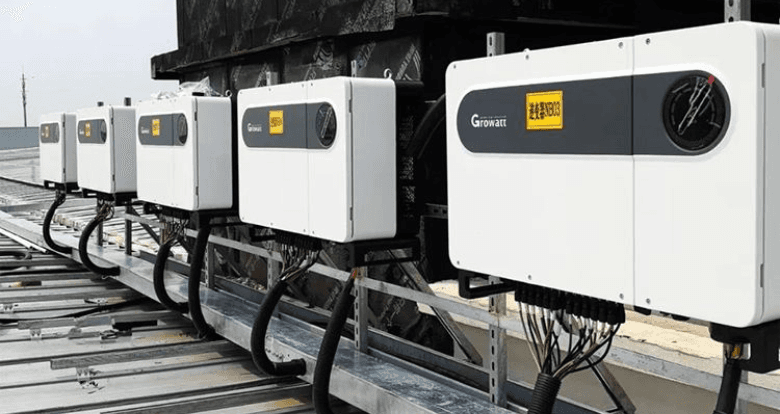
The MPPT controller can detect the output voltage of the solar panels in real-time and track the maximum voltage and current values (VI), allowing the system to charge the battery with maximum power output. It is applied in solar photovoltaic systems, coordinating the operation of solar panels, batteries, and loads, acting as the brain of the photovoltaic system. The maximum power point tracking system is an electrical system that adjusts the operating state of electrical modules to enable photovoltaic panels to output more electrical energy, effectively storing the direct current generated by solar panels in batteries. It can effectively solve the electricity needs of remote areas and tourist regions that conventional power grids cannot cover, without causing environmental pollution.
1. The Role of MPPT#
What is the role of MPPT? Due to the influence of external factors such as light intensity and environment on solar cells, their output power varies. The photovoltaic inverter with MPPT maximum power tracking is designed to fully utilize solar cells, ensuring they operate at the maximum power point. In other words, under constant solar radiation, the output power with MPPT will be higher than without it. For example, if MPPT has not started tracking yet, and the module output voltage is 500V, once MPPT starts tracking, it begins to adjust the resistance in the circuit through its internal structure to change the module output voltage while also changing the output current until the output power reaches its maximum (assumed to be 550V maximum). After that, it continues to track, meaning that under constant solar radiation, the module will output more power at 550V than at 500V. This is the role of MPPT.
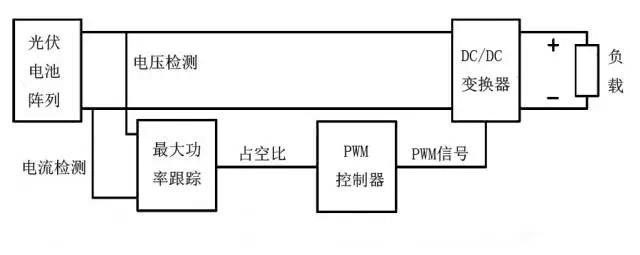
The principle of maximum power point tracking, with the development of electronic technology, is generally achieved through DC/DC conversion circuits.
The principle block diagram is shown below. The photovoltaic array is connected to the load through the DC/DC circuit, and the maximum power tracking device continuously detects the current and voltage changes of the photovoltaic array and adjusts the duty cycle of the PWM drive signal of the DC/DC converter based on these changes.
2. The Principle of MPPT#
For linear circuits, when the load resistance equals the internal resistance of the power source, the power source outputs maximum power. Although photovoltaic cells and DC/DC conversion circuits are strongly nonlinear, they can be considered linear circuits over very short periods. Therefore, as long as the equivalent resistance of the DC-DC conversion circuit is adjusted to always equal the internal resistance of the photovoltaic cell, the maximum output of the photovoltaic cell can be achieved, thus realizing the MPPT of the photovoltaic cell.
Currently, there has been some research on the maximum power point tracking (MPPT) technology of photovoltaic arrays, and various control methods have been developed, commonly including the following:
(1) Constant Voltage Tracking (CVT)
(2) Perturbation and Observation method (P&O)
(3) Incremental Conductance method (INC)
(4) Gradient-based variable step size conductance increment method, etc.
(These algorithms can only be used under unobstructed conditions)
-
The MPPT algorithm for single peak power output Currently, under unobstructed conditions, the commonly used control methods for maximum power point tracking (MPPT) of photovoltaic arrays include the following: Constant Voltage Tracking (CVT), Perturbation and Observation method (P&O), Incremental Conductance method (INC), Gradient-based variable step size conductance increment method, etc.
-
Multi-peak power output MPPT algorithms Ordinary maximum power tracking algorithms, such as perturbation observation and incremental conductance methods, may fail under cloud cover and cannot achieve true maximum power tracking. Currently, there are proposals for multi-peak MPPT algorithms internationally, mainly including the following three: composite MPPT algorithms combining conventional algorithms, Fibonacci method and short-circuit current pulse method.
In summary: The industry has recognized the importance of multiple MPPT channels in inverters, and multi-MPPT string photovoltaic inverters have been widely recognized.
The article is reproduced from 【Inverter】 The Role, Principle, and Algorithm of Photovoltaic Inverter MPPT